
Erika Hornmark
A content writer at aboveA, passionate about crafting impactful stories that connect with audiences. Studying political economy and statistics at UC Berkeley, I blend analytical insight with creative storytelling to help businesses grow and connect with their audience.
Why E-E-A-T Is Your Best SEO Strategy This Year
- Last time updated: 25th of May, 2026
Google E-E-A-T matters because search results are no longer judged only by keywords, structure, or page length. They are judged by trust. Imagine two websites publish advice on the same topic. One article is written or reviewed by someone with real experience, clear expertise, named sources, practical examples, and a visible author. The other is a fast AI-generated post with no proof, no clear writer, no examples, and no reason to trust the claims.
Which page gives the reader more confidence?
That is the point of E-E-A-T: Experience, Expertise, Authoritativeness, and Trustworthiness. It helps show who created the content, why they understand the topic, what proof supports the advice, and whether users can rely on it. In a time when AI can produce quick content at scale, Google E-E-A-T helps separate useful content from empty pages built only to rank.
Start your E-E-A-T optimization today - book a free content audit with aboveA!
Table of Contents
Why Google Cares About E-E-A-T
Google cares about E-E-A-T because Search is built to surface helpful, reliable content for people, not pages created only to manipulate rankings. When content gives unsafe advice, hides who made it, copies claims, or uses AI to publish thin answers at scale, users lose trust. That is why Google’s guidance returns to experience, expertise, authority, and trust.
Google looks at content quality through many signals. Key areas include:
- Authorship: Show who created or reviewed the content, what their background is, and why they are qualified to explain the topic.
- Evidence: Claims should match reliable sources, direct experience, product knowledge, expert review, or documented examples. Strong references support trust.
- Freshness: Important pages should be reviewed, updated, and corrected when facts, prices, rules, or recommendations change. Old content loses value when the topic moves.
- Transparency: Readers should understand who runs the site, how to contact the business, what the page is trying to do, and whether any commercial interest shapes the advice.
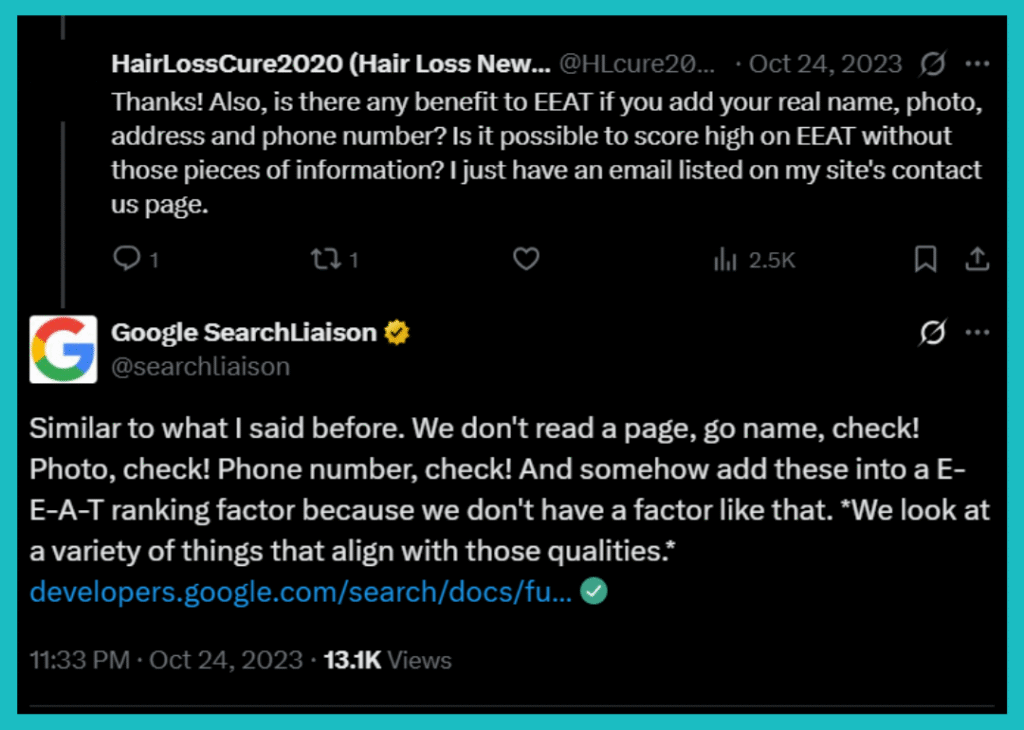
E-E-A-T is not a simple score. Google says its systems aim to reward helpful, reliable, people-first content, while quality raters use E-E-A-T to assess whether results feel useful and trustworthy. For your website, this means every important page should prove who is behind the content, why they can be trusted, and what evidence supports the advice.
Once that foundation is clear, you can turn E-E-A-T into practical content improvements.
How to Improve E-E-A-T on Your Website
Show Real Experience
Including detailed narratives and substantiating your claims with other media (think screenshots, videos) can demonstrate how your content applies in the real world.
As an example, if you’re a business selling a certain online tool, start by showing how you use it! Make a quick video or interactive page on your website that guides you through your tool. If you prefer pictures or screenshots, consider labeling and annotating them!
Prove Your Expertise
It’s crucial to write an author bio. Provide certifications or cite past work and accomplishments pertinent to your subject. Including a photo and links to other professional websites and social media profiles can further boost your credibility.
Build Authority
Authority can come from proving your expertise and credentials, but it also comes from other sources. You can increase your content’s topical authority in SEO by tying it into related content. Making use of linking (onto different pages on your own website as well as other trusted sources), as well as interviews and guest contributions from other authorities in the field, can build your recognition.
Earn Trust
Trust can be earned in a variety of ways, but consider the following:
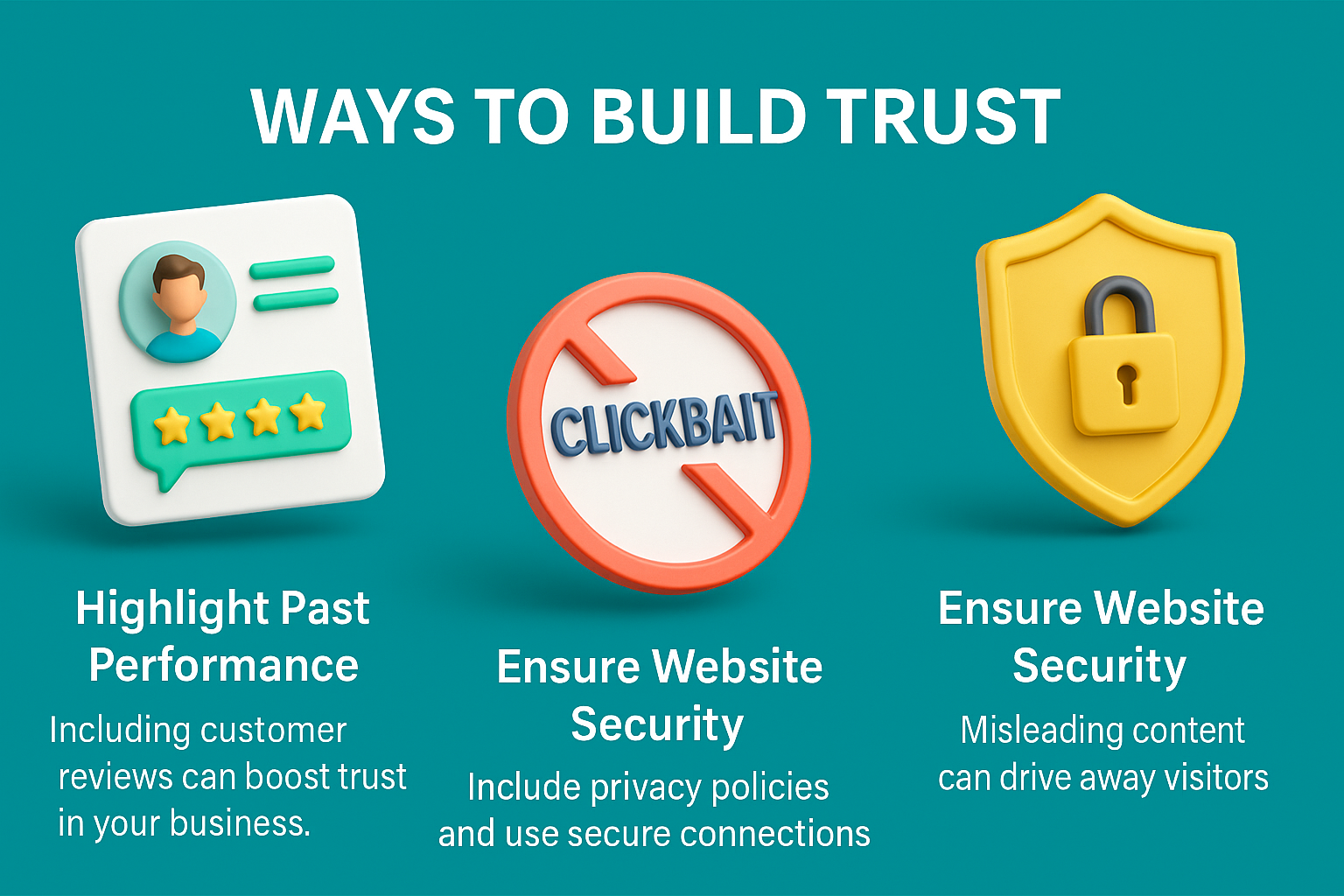
- Highlighting past performance. Including customer reviews (consider for your product: do longer corporate testimonials or shorter star reviews make more sense) can boost customer trust in your business and its associated products and services.
- From a more technical standpoint, including privacy policies, disclosures, and terms of service can make some customers feel safer. You can take further initiative by making sure that your website is also using secure (HTTPS) connections.
- Avoiding clickbait or misleading content. This will likely dissatisfy page viewers, causing them to abandon the page early, and may lead to your page becoming ranked lower on search engines.
Building Authority with AI-Driven Content Distribution
AI can be a great tool for both producing and sharing content, but only if it’s used responsibly and within limits. It’s important to avoid overpromising AI capabilities. Even if tools claim to be “AI-driven,” don’t trust them unless their claims have been substantiated. In the worst case, irresponsible AI use can mislead potential customers and may leave poor reviews. In this scenario, Google will absolutely notice and push your content further down in the search engine.
AI is a supporting tool, not the dominant workhorse. Here are some tips to responsibly leverage AI in building authority:
- Be aware of bias and the potential inaccuracy of AI-generated content
- Include information about the human author of the content
- Monitor and update content regularly. Industry trends and knowledge are constantly changing, and the more frequently you modify your content to ride these waves, the more likely you are to have your content boosted in search engines.
How to Use AI to Support Expertise Without Faking It
AI can be an incredibly powerful tool in content creation, but it does have its limitations. Using AI responsibly can help streamline production, but it should never replace true experience. Consider following these guidelines to make the most of AI:
- When you’re stuck on an outline, have it generate a guide for you.
- When you’re looking for additional data to back up your claims, have it gather the data for you. A massive caution to take with this process is that you must verify the data by checking the sources with your own eyes. Sometimes links can be faulty or take information out of context.
- Make sure to pair AI assistance with human insights. Case studies, non-AI-generated visual media, and author bios can ‘humanize’ your work.
- Disclose AI usage when relevant. Never pass off AI-generated insights as personal experiences or ideas. For further information, be sure to check out Google’s guidelines on AI-generated content.
AI and Trust: How to Avoid Losing Credibility
AI and trust matter in 2026 because content is easier to produce, but harder to believe. A brand can publish articles faster, build pages quicker, and answer more search intents with AI. The risk is that speed can remove the proof. When content has no author, no sources, no examples, and no human review, users can sense that something is missing.
Google does not reject content just because AI helped create it. Its guidance says the problem is content made at scale without real value for users. Google also updated its spam policies in 2026 to clarify that attempts to manipulate AI-generated Search responses can be treated as spam. That makes trust a search issue, not only a brand issue.
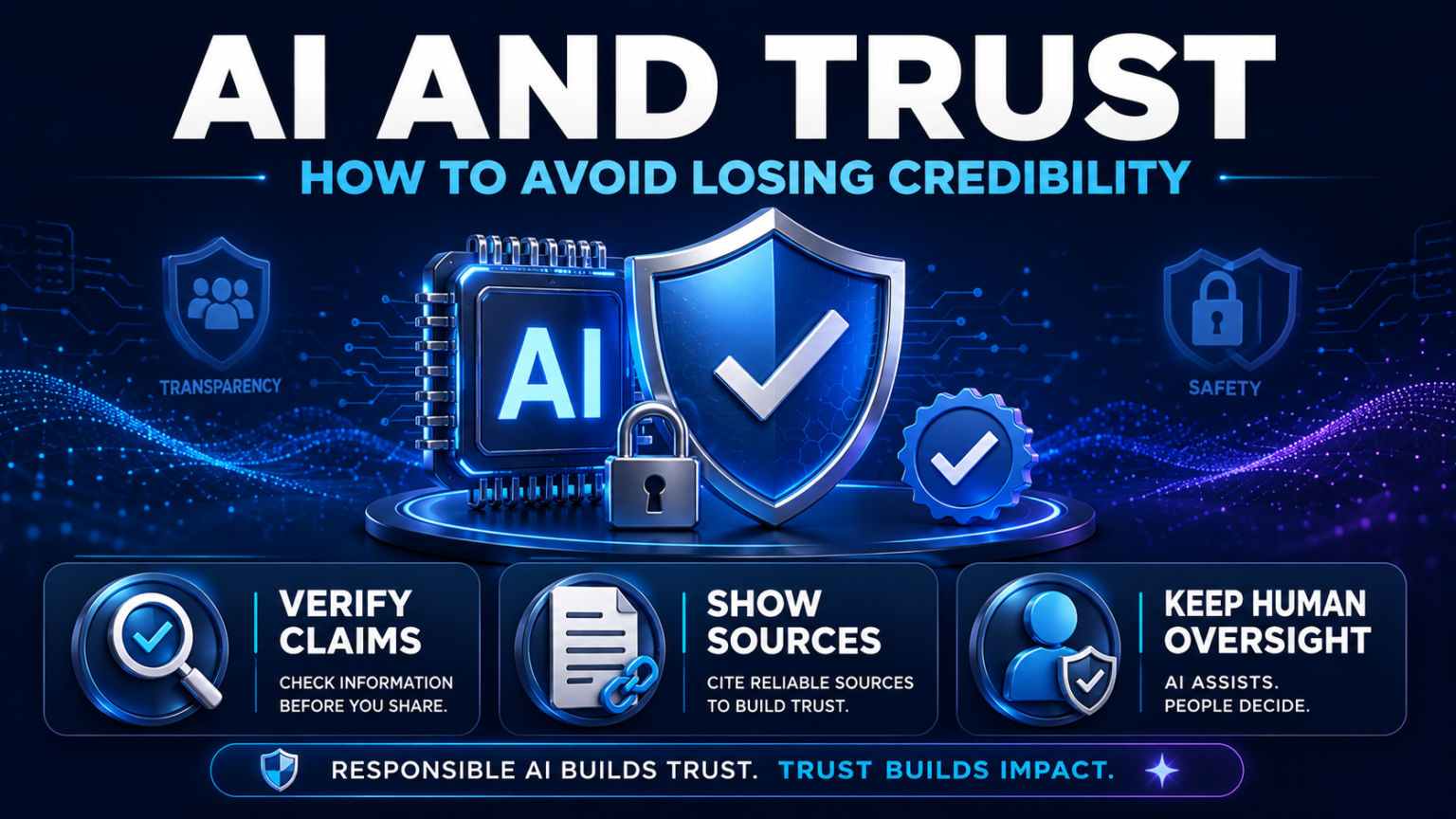
To avoid losing credibility, use AI as support, not as the final authority. Add named authors, expert review, first-hand examples, original screenshots, real data, clear sources, and update notes. If AI helped with research, structure, or drafting, the final page still needs human judgment. NIST’s AI Risk Management Framework also links trustworthy AI use with governance, transparency, accountability, and risk control.
Trust is also becoming a wider business problem. Edelman’s 2026 Trust Barometer describes a world becoming more closed and skeptical, where people retreat into familiar sources. In that environment, vague AI content can damage confidence quickly. Strong E-E-A-T helps show that real people, real proof, and real responsibility sit behind the page.
Aligning SEO with E-E-A-T
SEO audits are analyses that can be conducted to evaluate website performance across technical, on-page, and off-page metrics. These determine the search visibility of your website. SEO audits will identify problems on your website impacting site authority, trustworthiness, and user experience.
Tools for SEO Audits
Performing E-E-A-T audits will help you verify that your content is in line with Google’s standard of trust and authority. Numerous tools exist to help you conduct SEO audits, including:
- Semrush: includes a free trial for a week. After scanning your site, they will list top issues with your site that can be easily fixed using their software. Learn more about your site’s crawlability, speed, and performance, and on-page SEO using Semrush.
- Google Search Console: Google Search Console is a free, comprehensive SEO auditing tool. The platform is focused on webmaster tools, fit for reporting on technical elements. While their free SEO tools are a little harder to navigate, when combined with other platforms like Google Analytics, which provide real-time reports on key site performance indicators, mastering the tools can unlock lots of new insights.
- Morningscore: Morningscore is a beginner-friendly SEO auditing tool. Their unique gamified SEO tasking will let you keep track of your site optimization process. While their services are more limited compared to the other two, they have different pricing tiers ranging from $49 to $259 a month (with an additional two-week free trial!) with varying capabilities.
What do SEO Audits Reveal?
SEO auditing tools perform numerous tasks, but are particularly helpful to assess various metrics, including:
- Backlinks (both their location and quality)
- Keyword performance
- Domain authority
- Site security
What Can I Do With SEO Audit Results?
Once you get feedback from SEO auditing tools, you can accordingly edit
- Business details, including address, policies, and team information.
- Reviews, to make sure they’re detailed and transparent
- All public-facing content to verify cleanliness and accuracy
- All content is to ensure it provides insightful, relevant information
How to Audit Your Current E-E-A-T Signals
An E-E-A-T audit reviews whether your website gives users enough reasons to trust your content, business, and advice. In 2026, this matters even more because AI can create content quickly, but Google still rewards content that is helpful, reliable, and made for people. Google’s guidance asks creators to think about who made the content, how it was produced, and why it exists.
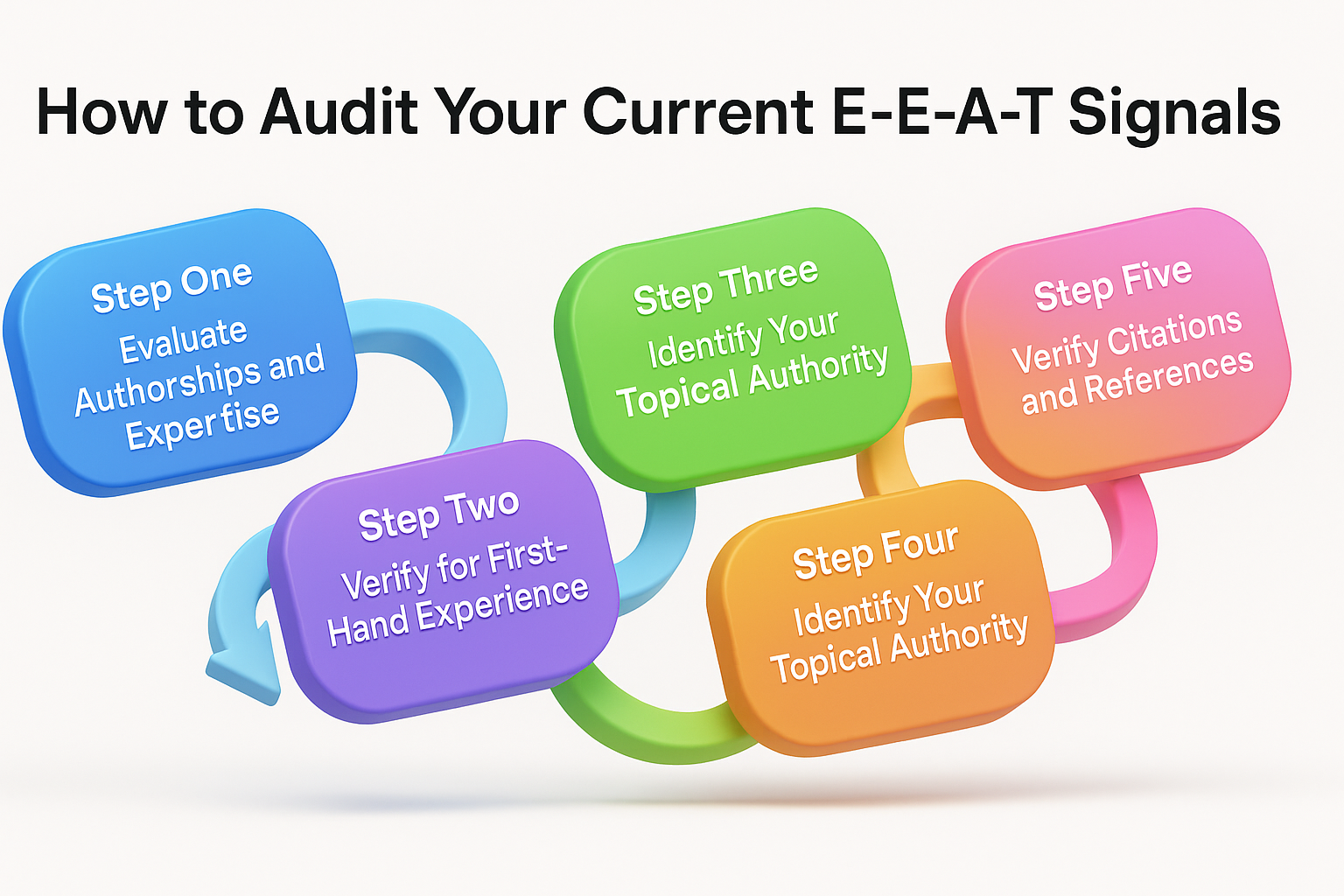
Step One: Evaluate Authorship and Expertise
Start by checking your most important pages and articles. Each page should make it clear who created or reviewed the content. A visible author name, short bio, role, credentials, or direct experience can help users understand why the person is qualified to speak on the topic. This is especially important for finance, health, legal, safety, or business advice, where weak or anonymous content can damage trust. If users cannot tell who stands behind the page, the content already has a credibility gap.
Step Two: Verify for First-Hand Experience
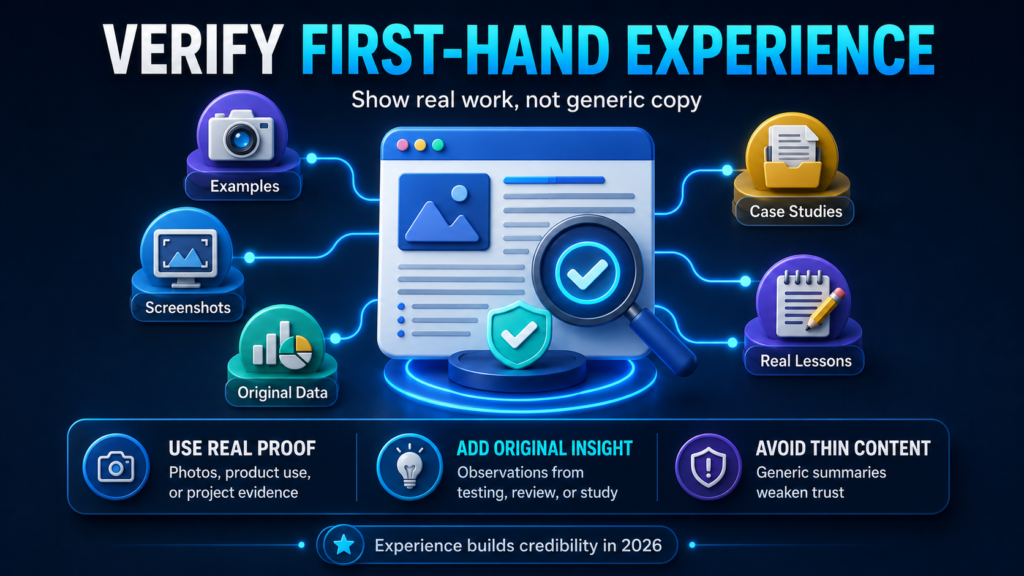
Next, look for signs of real experience. A strong page should include examples, screenshots, original data, case studies, photos, product knowledge, project lessons, or clear observations from real work. This helps separate useful content from generic AI-written text. A page that only repeats what already exists elsewhere will look thin, even if it is grammatically clean. In 2026, content should prove that someone has tested, used, studied, reviewed, or worked with the topic in a meaningful way.
Step Three: Identify Trust Elements Across the Website
E-E-A-T is not only about blog posts. Your whole website should make the business easy to verify. A clear contact page, About page, privacy policy, terms, service details, refund rules, security, reviews, testimonials, and real proof points all support trust. These details matter because users often check them before making a decision. If the site hides basic business information, even strong content can feel less reliable.
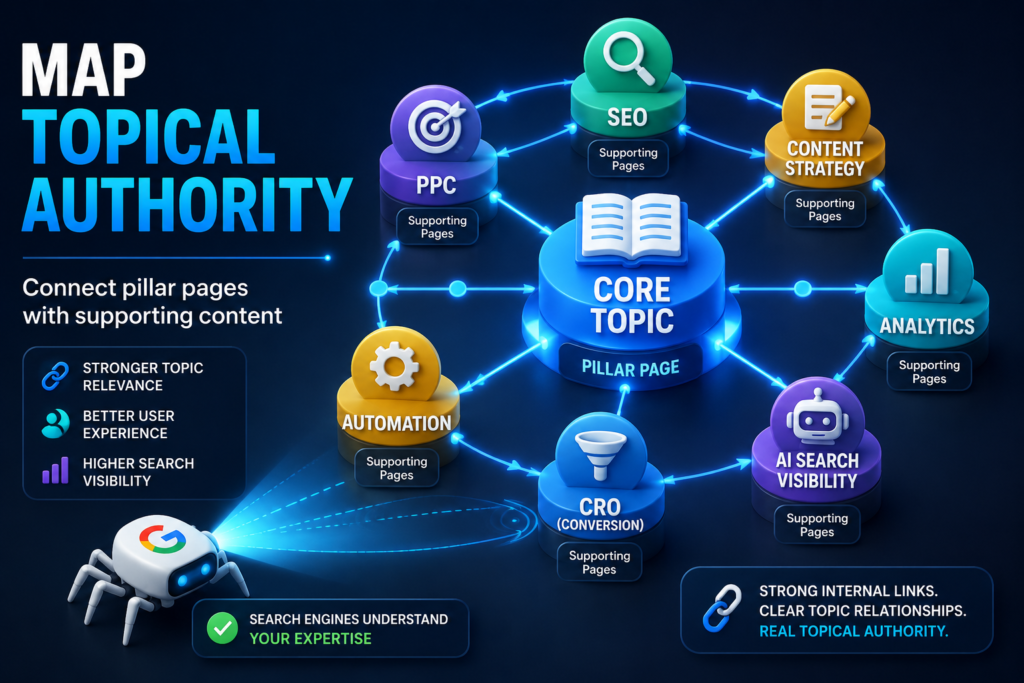
Step Four: Identify Your Topical Authority
Topical authority comes from covering a subject with depth and clear structure. Instead of relying on one broad article, your site should connect pillar pages with related supporting pages. For example, a digital marketing site should cover SEO, PPC, content strategy, automation, analytics, conversion, and AI search visibility as connected topics. Internal links should guide users naturally from one useful page to another. This helps search engines understand what your site knows and helps readers explore the topic without getting lost.
Step Five: Verify Citations and References
Finally, check whether your claims are supported by strong sources. Statistics, legal details, health claims, prices, rankings, and fast-changing trends should link to current and trusted references. Government websites, universities, official company pages, and established industry sources are usually stronger than random blogs. Old statistics should be replaced, broken links should be fixed, and every source should support the exact claim near it. Citations should not be decorative. They should help users trust what they are reading.
A proper E-E-A-T audit should end with one simple question: does this website give users enough proof to trust the content and the business behind it? If the answer is weak, improve the page before publishing more content. Add clearer authorship, stronger examples, better sources, fresh updates, transparent policies, and useful internal links. In 2026, SEO is not only about being found. It is about being believed.
Case Studies: Brands Winning with E-E-A-T in 2026
Deloitte
Deloitte is a business-to-business (B2B) service-based company providing auditing, consulting, and advisory services. Deloitte maintains strong authoritativeness by producing extensive content hubs. Deloitte’s white papers, economic forecasts, and commentary are produced by employees with deep industry knowledge. By citing experts with complete bios and external presence (i.e. LinkedIn) showcasing their experience and expertise. By following through with frequent updates and structured navigation, their Insight Hub is a trustworthy, E-E-A-T-friendly source of information.
On Deloitte’s blog, for example, they’ve uploaded an article weighing the challenges of Covid-19 in the workplace. They clearly state the authors, “three finance and transformation leaders” at the top, and mention their credentials and experience further in the article.

HubSpot
HubSpot is a B2B software-as-a-service (SaaS) company providing businesses with software and customer relationship management (CRM) tools to boost outreach. They leverage their expertise in the field with their blog and resource centers curated by established marketing professionals. Their articles often link to original research findings and customer case studies, providing new, relevant insights into the industry.
Their content includes long-form content like guides and how-tos, expert commentaries, and articles cross-linked to their relevant tools. Their long-form content is often accompanied by webinars, videos, and data visualizations to diversify their content. When advertising their services, they build trustworthiness by including transparent product reviews on third-party platforms like TrustRadius to make potential customers feel safer.

REI: Recreational Equipment, Inc.
REI is a consumer-facing business-to-consumer (B2C) brand selling outdoor gear and lifestyle goods. They target potential customers with a blog with expert advice sections featuring articles from experienced outdoor sportsmen and professionals. Leveraging their unique experience and expertise, they compile real-world use cases for their goods, including product recommendations backed by testing.
Their products are sold alongside a transparent return policy, verified reviews, and extensive gear tests. REI drives engagement and interest in their products using Google E-E-A-T signals in a very crowded B2C space.
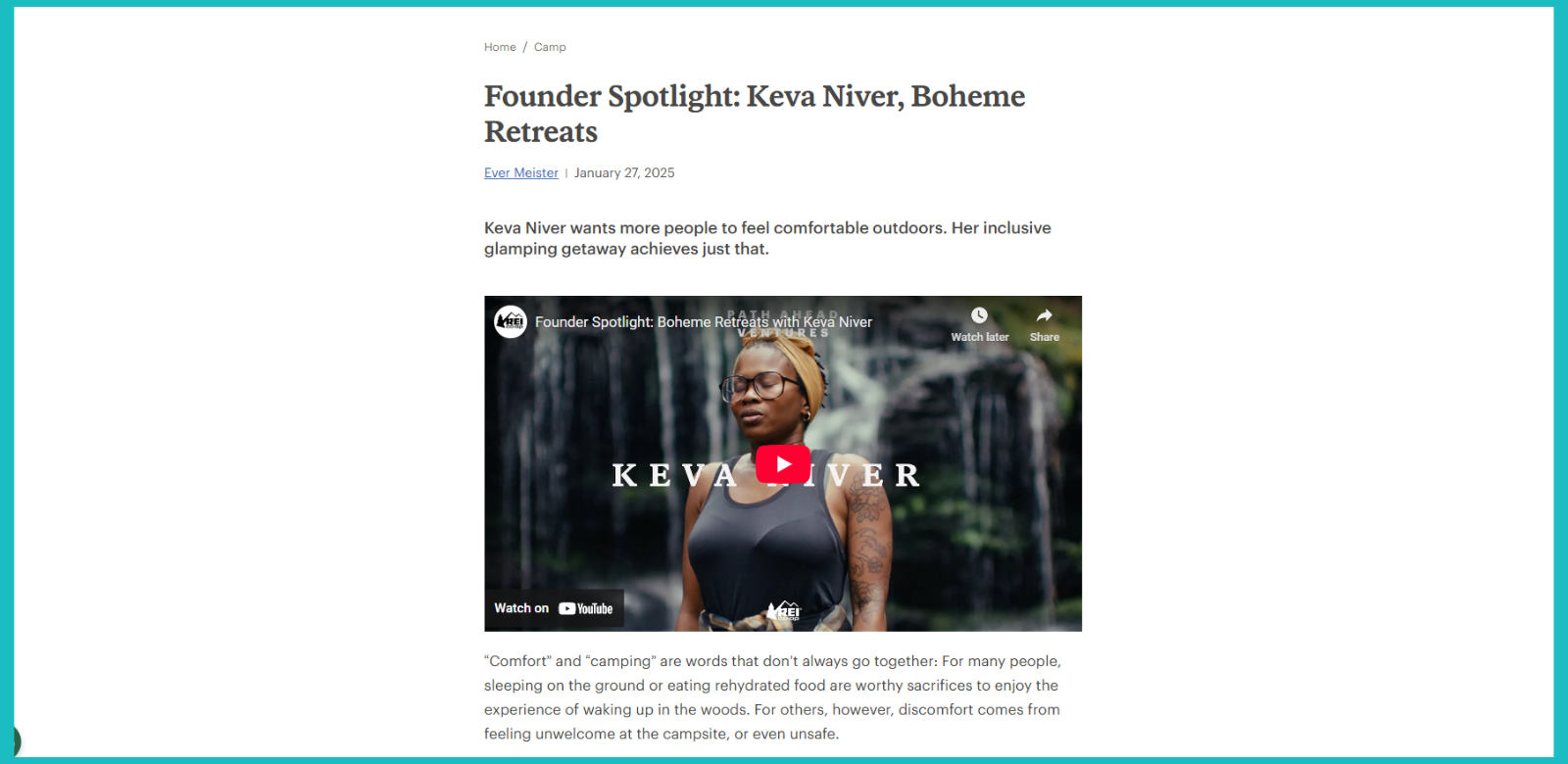
REI uses its blog site not only for long-form text but also for well-produced videos relevant to its consumer base. The article spotlights an accomplished entrepreneur in the nature and wellness space in a unique media format, a welcome change of pace.
Common Mistakes People Make with E-E-A-T
E-E-A-T audits can improve trust, but they often fail when teams treat them like ordinary SEO checks. Before fixing pages, you need to understand the common mistakes that weaken credibility, confuse users, and limit how well content performs in search.
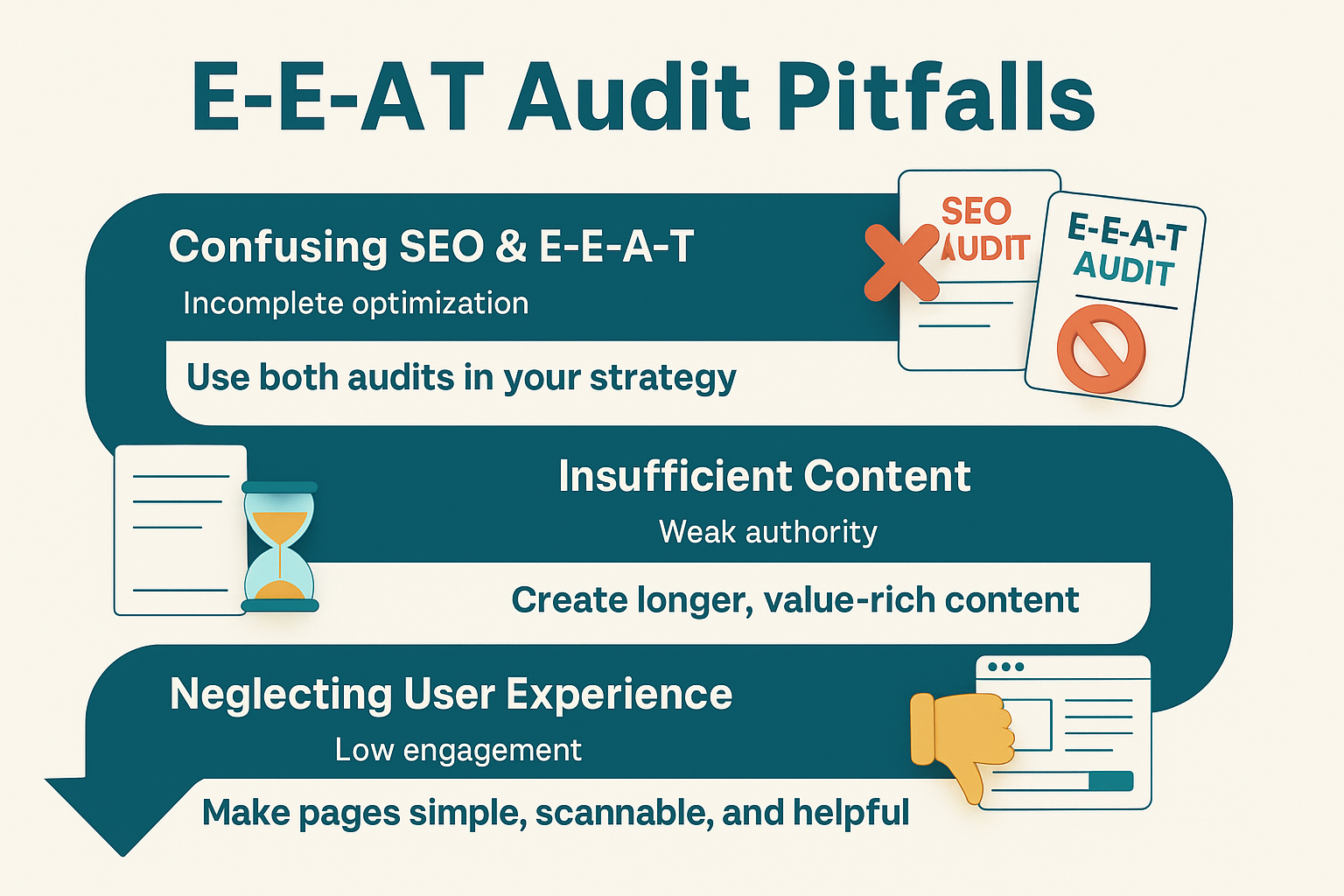
Confusing SEO and E-E-A-T Audits
One common misconception is that SEO audits and conducting E-E-A-T audits are the same. They have a common goal of improving search visibility and website performance, but they individually focus on different parts of optimization.
A standard SEO audit will focus more on technical and structural factors that affect how search engines parse through your content and rank your site. Technical factors can range from page speed, mobile-friendliness, formatting, site architecture, and more.
On the other hand, auditing E-E-A-T signals tends to be more focused on written site content. It evaluates site content credibility and trustworthiness based on search engine guidelines. These include author credentials and bios, first-hand accounts, and trust elements like HTTPS, customer reviews, and company information.
SEO audits are about how your site functions, while E-E-A-T audits are about who is behind the website content and why it can be trusted. Overall, combining the two creates a complete strategy to tackle any challenges with site performance and credibility.
Insufficient or Irrelevant Content
Your content should be comprehensive and valuable. Short blog posts are very rarely checking off both of these boxes. Long-form content gives you ample time to provide value, solutions, and unique content. Creating in-depth, customer-focused content will help your site resonate with viewers and keep them coming back.
Neglecting User Experience
It can be easy to get sucked into wanting to optimize your site by packing as much information onto your page as possible. However, this is not the most effective approach. Website users don’t typically like being bombarded with walls of text and hyperlinks. It’s important to strike a good balance between optimizing SEO and E-E-A-T signals and making your site content easy to navigate, not overwhelming, and relevant to your audience.
If you’re ever unsure of whether you’ve gone overboard, ask a friend to take a first look at your page. It’s easier to measure SEO optimization levels with tools, but sometimes it can be valuable to get a fresh set of eyes on your site content.
Action Plan for E-E-A-T SEO Strategy in 2026
Confused about how to start implementing effective E-E-A-T SEO strategies on your site, so you can see your online growth scaling steadily? Follow the checklist below to make your work more SEO-friendly.
- Audit your site for E-E-A-T Signals
- Conduct an SEO Audit and listen to relevant recommendations
- Over time:
- Continue to invest in long-form, informative content
- Continue to use various forms of media. Using a blend of written, image, and video content will keep viewers engaged
- Continue to treat AI as a supportive tool, not a one-size-fits-all solution to content problems
- Continue to monitor content for necessary updates
- Use SEO tools to further monitor site trustworthiness and viewership. As a general benchmark, for a content-heavy site, you should be conducting both an E-E-A-T and SEO Audit once every one or two months.
Conclusion
E-E-A-T is not a direct ranking factor that Google uses to rank results. However, it’s an important framework that Google uses to determine what content is trustworthy and thus gets boosted in search engines. As search engines continue to evolve and become more intelligent, E-E-A-T will become increasingly important as it’s used to judge site trust, page authority, and content credibility. Your content should focus equally on informative, interesting content and E-E-A-T in order to maximize SEO authority growth.
Google EEAT Frequently Asked Questions
How does Google evaluate Experience, Expertise, Authoritativeness, and Trustworthiness?
Google’s search algorithm uses signals like author credentials and bios, real-life examples, external links and citations, site reputation, and content quality in order to evaluate E-E-A-T.
What role do backlinks play in improving authority?
Backlinks coming from high-quality, reputable sources are essentially a vouch of confidence for your content. Google reads them as a sign that your content is trustworthy and recognized as such as by others, increasing your algorithmic authoritativeness and thus SEO domain authority.
How can ecommerce websites apply E-E-A-T principles?
Ecommerce sites can implement E-E-A-T principles by leaning into high-quality verified reviews, including author bios for any long-form content (think buying guides or seasonal blog posts), clearly outlining return/exchange policies and product information, and having secure payment processes.
How often should you update content for better E-E-A-T?
Depending on how trend-sensitive or fast-growing your industry is, the timeline can look different. In general, updating your content every 6 to 12 months will help you to maintain accuracy in your content.
